0%

An Aluminium Entrance Door is an exterior door made with engineered aluminium profiles, panels, glass, and protective hardware. It creates the main transition between a building and the outside world. Aluminium is lightweight, strong, and naturally resistant to rust, making it suitable for busy entrances and changing weather conditions.

Its appearance can range from slim, modern frames to solid panels with textured finishes. Powder coating adds colour and helps protect the surface from everyday wear. Many systems also include thermal breaks, which reduce heat transfer through the frame. This detail matters during cold mornings or hot afternoons. However, aluminium alone does not guarantee good insulation. The complete door system matters more.

In practical installations, careful measuring makes a noticeable difference. Experienced installers check the opening, threshold, hinges, seals, and surrounding wall before fitting the door. A small gap can cause drafts, rattling, or water entry. It may look minor. It rarely feels minor in winter.

A dependable Aluminium Entrance Door should have clearly stated performance information. Look for details about security hardware, glazing, weather sealing, thermal efficiency, and finish durability. Reputable manufacturers normally provide technical specifications and maintenance guidance. Independent installation experience also adds valuable insight, because even an excellent product can perform poorly when fitted carelessly.

There is no perfect entrance door. Design, climate, exposure, budget, and daily use all influence the right choice. A thoughtful comparison helps homeowners avoid choosing only by appearance. The most attractive door may not be the most comfortable, secure, or practical option for the building.
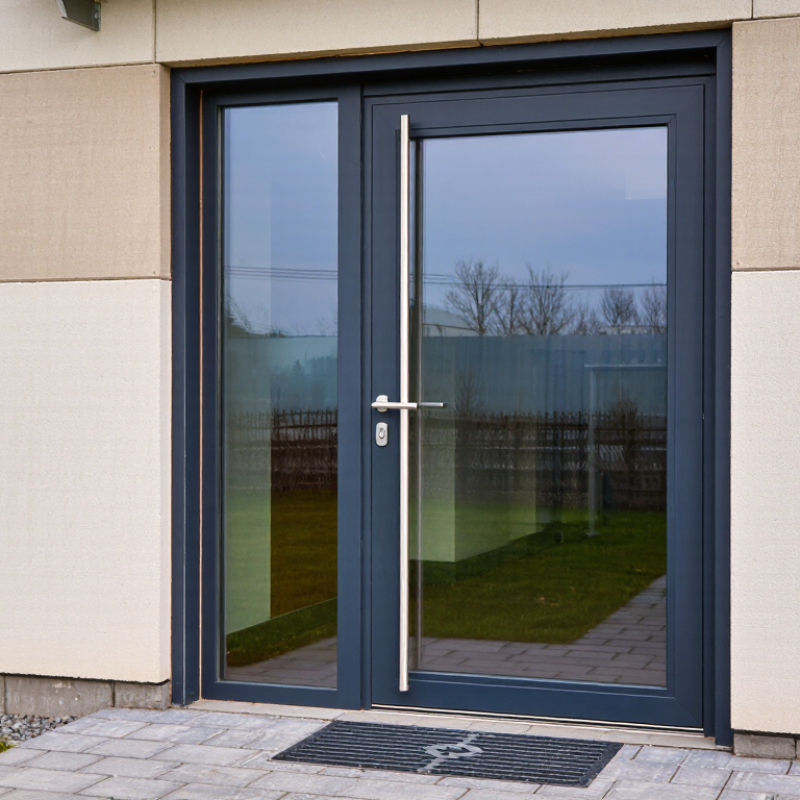
What Is an Aluminium Entrance Door?

Aluminium Entrance Door Definition: 2.70 g/cm³ Density and 6063-T5 Frames

An aluminium entrance door is an exterior door system built around lightweight metal profiles, hardware, seals, and glazing or panels. Aluminium has a density of about 2.70 g/cm³, so it weighs far less than steel at comparable volume. That lower mass helps installers position large door leaves with less strain. It does not mean every aluminium door feels light. Thick profiles, laminated glass, locks, and reinforced hinges add substantial weight. On a real project, the complete assembly matters more than the metal figure.

6063-T5 is a common architectural aluminium specification for frames. “6063” identifies the alloy, while “T5” describes its heat-treatment condition after extrusion. The material supports clean profiles, useful corrosion resistance, and a smooth surface for finishing. Its performance still depends on wall thickness, corner joints, drainage paths, and coating quality. A profile may look robust but flex if its sections are poorly proportioned. Details matter.

At the threshold, installers should check the opening, sill level, packers, and seal compression. A small gap can admit wind-driven rain. Thermal breaks can reduce heat transfer, but they cannot correct a badly aligned frame. I have seen attractive doors fail because the threshold drained toward the room. That mistake is easy to miss. Measuring the frame, checking hinge loading, and testing the lock after installation provide more reliable evidence than density or alloy labels alone.

How Aluminium Door Panels, Thermal Breaks, Seals, and Hardware Work Together

What Is an Aluminium Entrance Door?

How Aluminium Door Panels, Thermal Breaks, Seals, and Hardware Work Together

An aluminium entrance door uses rigid metal panels around a practical opening system. The panel provides strength and a clean, stable surface. However, metal conducts heat easily. Without insulation, winter air can make the interior face feel cold and uncomfortable.

A thermal break separates the outer and inner aluminium sections with an insulating strip. This reduces heat transfer through the frame. It can also limit condensation around the edges. The result depends on correct assembly, not only on the material itself. Small gaps matter. A poorly fitted panel may still leak air.

Seals complete the weather barrier. Flexible gaskets press against the panel and frame, blocking drafts, rain, and outside noise. They need even contact at the corners. Hardware controls how that pressure is created. Hinges carry the door weight, while locks and handles pull the panel firmly against the seals. Adjustable hinges are especially useful when the door settles slightly after installation.

On site, I would check the closing line with a simple sheet of paper. If it slides out easily, the seal may not be compressing enough. It is a basic test, but useful. A detailed specification cannot repair careless fitting. Even a strong aluminium door may perform poorly when the frame is twisted or the threshold is uneven. That is the part many projects underestimate.

What Is an Aluminium Entrance Door? - How Aluminium Door Panels, Thermal Breaks, Seals, and Hardware Work Together

Door Element Typical Material or Construction Common Dimensions or Ratings Primary Function How It Works with Other Components Relevant Performance Indicator
Aluminium Door Panel Insulated aluminium-faced panel with a rigid core, or a glazed panel using insulated glass. 40–90 mm panel thickness
Common single-door widths: 800–1,000 mm
Forms the main moving barrier and provides structural support, weather protection, and visual appearance. The panel transfers loads to the hinges, compresses the seals against the frame, and contains or supports the thermal-break system. Panel flatness, stiffness, surface durability, and the overall door U-value.
Aluminium Door Frame Extruded aluminium profiles assembled around the opening, often with separate interior and exterior profile sections. 60–120 mm frame depth
Profile wall thickness commonly about 1.5–3.0 mm
Supports the door leaf, anchors the hinges and lock hardware, and transfers operating loads to the building structure. The frame holds the seals and thermal barrier in fixed positions while providing the alignment needed for reliable locking. Frame rigidity, dimensional stability, air leakage, and water-tightness.
Thermal Break Low-conductivity polyamide insulating strips placed between the inner and outer aluminium profile sections. 18–34 mm polyamide strip width
Actual dimensions vary by profile system and required thermal performance.
Reduces direct heat flow through the highly conductive aluminium frame and limits interior surface cooling. Works with insulated panels, sealed glazing, and perimeter gaskets to reduce heat loss and help control condensation risk. Frame thermal transmittance, whole-door U-value, and interior surface temperature.
Weather Seals and Gaskets Flexible EPDM or thermoplastic rubber compression seals installed around the panel and frame. Usually 2 or 3 continuous sealing lines
Seal compression commonly about 2–5 mm
Blocks drafts, rainwater, dust, and sound paths around the perimeter of the closed door. The lock and hinges must position the panel accurately so the gaskets compress evenly without excessive friction or gaps. Air permeability, water penetration resistance, acoustic insulation, and seal recovery after repeated use.
Insulated Glass Unit Double-glazed or triple-glazed unit with sealed cavities, commonly filled with air or argon. Typical double glazing: 24–32 mm overall thickness
Typical triple glazing: 36–52 mm overall thickness
Provides daylight and visibility while improving thermal and acoustic performance compared with single glazing. The glazing spacer, glazing gasket, panel rebate, and frame must work together to maintain edge sealing and prevent movement. Glass U-value, solar control, visible light transmission, and sound reduction.
Multipoint Lock Lock case connected to several locking points, such as hooks, rollers, or bolts along the door edge. Commonly 3–5 locking points
Backset often about 35–45 mm
Improves security and distributes closing pressure along the full height of the door. Even locking pressure helps compress the perimeter seals uniformly and reduces air or water leakage at the corners. Locking reliability, resistance to forced entry, operating force, and seal compression consistency.
Cylinder and Escutcheon Mechanical or electromechanical cylinder protected by an exterior escutcheon or protective fitting. Common cylinder formats include double-cylinder and thumb-turn types. Controls key-operated access and protects the lock mechanism from tampering and environmental exposure. The cylinder operates the central lock case, which transfers movement to the additional locking points in the door edge. Key control, pick resistance, corrosion resistance, and compatibility with the lock case.
Hinges Adjustable aluminium or steel-supported hinges designed for the door leaf weight and opening frequency. Usually 3 hinges for a standard entrance door; heavy or tall doors may require additional support. Carries the door leaf and allows controlled opening, closing, and adjustment. Hinge adjustment keeps the panel aligned with the frame, allowing the seals and locking points to engage correctly. Load capacity, cycle durability, vertical adjustment range, and alignment stability.
Threshold Thermally improved aluminium threshold with a raised or low-profile step and integrated drainage provisions. Common threshold heights: 15–25 mm
Accessible low thresholds may be about 15–20 mm
Closes the bottom edge, supports weather resistance, and guides water toward drainage paths. The bottom seal must meet the threshold continuously while the frame drainage channels remove water that passes the outer seal. Water penetration resistance, trip safety, accessibility, and thermal bridging at the sill.
Door Closer or Operator Surface-mounted, concealed, or floor-supported mechanical closer; automatic operators may be used for access-control applications. Closing force commonly selected from EN power sizes 2–5, depending on door width, weight, and exposure. Controls closing speed and helps return the door to the locked position after opening. Correct closing force ensures the latch engages and the seals compress without slamming or excessive operating resistance. Closing-cycle consistency, latching reliability, accessibility, and resistance to wind pressure.
Drainage and Pressure-Equalisation Paths Small concealed channels and external weep openings within the frame and threshold. Opening sizes and locations depend on the profile design; channels are normally positioned below exposed rebates. Collects and evacuates water that reaches the outer drainage chamber instead of allowing it into the building interior. Functions with external seals, glazing gaskets, threshold geometry, and correct installation to manage wind-driven rain. Water penetration resistance and reliable drainage under pressure differences.
Installation Joint Perimeter gap sealed with backer material, low-expansion foam or insulation, and an interior/exterior sealant arrangement. Typical perimeter installation gap: approximately 10–20 mm, subject to opening tolerances and design. Connects the door frame to the wall while accommodating small movements and limiting air, water, and heat transfer. Even the highest-performing door can lose efficiency if the joint is poorly sealed or the frame is installed out of square. Installation air leakage, water resistance, thermal bridging, and frame plumb and level.

Note: Dimensions and performance ranges are typical design values for residential and light-commercial aluminium entrance doors. Final specifications depend on door size, profile design, glazing or panel configuration, hardware selection, climate, and installation quality.

Thermal Performance: Comparing U-Values and Aluminium’s 205 W/m·K Conductivity

What Is an Aluminium Entrance Door?

An aluminium entrance door combines a rigid metal frame with insulated panels, glazing, seals, and hardware. Its thermal performance depends on the complete door, not aluminium alone. Aluminium has a high thermal conductivity of about 205 W/m·K, so heat can travel through untreated metal quickly. This sounds alarming, but modern frames use thermal breaks. These insulating barriers separate the inner and outer aluminium sections, reducing heat transfer.

The U-value measures how much heat passes through the door assembly. Lower values generally indicate better insulation. However, compare the declared U-value carefully. Some figures describe the panel, while others represent the entire door, including glass and frame. From site inspections, poor installation can weaken an otherwise efficient product. Small gaps around the frame may create cold draughts, condensation, and uncomfortable floor-level chills. The seal matters more than many homeowners expect.

Tips: Ask for the complete door U-value, not only the centre-panel figure. Check the glazing specification, thermal-break design, gasket quality, and installation details. A warm-edge spacer can improve glazed sections. Use a qualified installer who can square the frame accurately. Even excellent materials perform poorly when compressed seals are uneven. This is easy to overlook. Also consider orientation, nearby radiators, and local weather exposure. U-values help comparison, but they cannot describe every comfort issue inside a real hallway.

Security and Weather Resistance: EN 1627 Classes and IP Rating Considerations

What Is an Aluminium Entrance Door?

An aluminium entrance door combines a lightweight metal frame with insulated panels, sealed joints, and tested locking hardware. Its security depends on the complete door set, not aluminium alone. EN 1627:2021 classifies resistance against forced-entry methods. RC2 represents resistance to basic attacks using common hand tools. RC3 requires stronger protection against tools such as a crowbar and longer attack exposure. Test durations are limited, not guarantees of permanent protection.

That distinction matters. A door certified as RC2 or RC3 has passed a defined laboratory test. It does not become invulnerable on a busy street. Installation quality, hinge protection, cylinder design, and the surrounding wall can reduce real performance. I have seen specifications focus on the frame while ignoring the threshold. That is a practical mistake.

IP ratings need careful interpretation. IEC 60529 defines protection against solid objects and water for electrical enclosures, not complete entrance doors. An IP rating may describe an integrated access-control component, but it cannot replace door weather testing. For the door itself, EN 12207 addresses air permeability, EN 12208 water tightness, and EN 12210 wind resistance. A well-specified entrance should match these results to local exposure, such as driving rain, coastal wind, or snow. IP54 sounds reassuring, yet it may say little about leakage beneath a door threshold. Check the tested assembly, installation conditions, and certification scope before comparing quotations.

Finishes, Maintenance, and Service Life: 60–120 μm Powder-Coating Standards

What Is an Aluminium Entrance Door?

An aluminium entrance door uses lightweight, corrosion-resistant aluminium profiles for its frame and panels. Its finish often comes from powder coating, where dry pigment is cured onto the metal. Many architectural specifications target 60–120 μm, but this range is not a universal legal standard. QUALICOAT Specifications for Quality Labels, 2024, commonly assess coating thickness, adhesion, appearance, and weather resistance together. Thickness alone proves very little.

A 60 μm coating may suit sheltered residential entrances. Exposed coastal or industrial locations usually demand stronger pretreatment and careful colour selection. At 120 μm, the surface can offer more coverage, but excessive thickness may create edge defects or uneven texture. Small details matter. Check corners, hinge zones, drainage paths, and cut edges during inspection. ISO 2360 provides a recognised method for measuring non-conductive coatings on conductive substrates.

Maintenance remains simple, not effortless. Rinse dust and salt with clean water, then use a soft cloth and mild detergent. Avoid abrasive pads and aggressive solvents. The American Architectural Manufacturers Association’s performance guidance links finish durability with testing, exposure, and maintenance conditions. Service life is therefore site-dependent. A well-installed door may perform for decades, yet poor drainage can shorten that period quickly. I would not promise a fixed lifespan without checking orientation, climate, cleaning habits, and coating class. Even a beautiful finish can age unevenly.

FAQS

What determines the thermal performance of an aluminium entrance door?

The complete door assembly matters. It includes the frame, insulated panel, glazing, seals, hardware, and installation.

Does aluminium’s high conductivity make the door inefficient?

Aluminium conducts heat quickly, at about 205 W/m·K. Thermal breaks separate inner and outer sections, reducing heat transfer. The frame still needs careful design.

What does a door U-value tell me?

A U-value measures heat passing through the door assembly. Lower values usually indicate better insulation. Ask whether the figure covers the whole door or only the panel.

How can poor installation affect comfort?

Small frame gaps may cause draughts, condensation, and cold floor-level air. Unevenly compressed seals can weaken an efficient product. This is easy to miss.

What details should I check before ordering?

Check the complete U-value, glazing specification, thermal-break design, gasket quality, and installation method. Warm-edge spacers may improve glazed sections. Ask for evidence, not vague promises.

What do RC2 and RC3 security classes mean?

RC2 indicates resistance to basic attacks with common hand tools. RC3 requires stronger protection and longer tested exposure. Neither class guarantees permanent protection.

Can a certified door still perform poorly in real use?

Yes. Hinges, cylinders, thresholds, surrounding walls, and installation can reduce performance. A strong frame cannot fix a weak threshold. I would inspect the complete door set.

Is an IP rating enough to judge weather resistance?

No. IP ratings mainly describe electrical enclosures and their protection from solids or water. Check air permeability, water tightness, and wind resistance for the complete door. Local rain and wind still matter.

Conclusion

An Aluminium Entrance Door is a durable, lightweight entry system typically built with 6063-T5 aluminium frames, a material with a density of approximately 2.70 g/cm³. Its performance depends on how the aluminium panels, insulated cores, thermal breaks, weather seals, glazing, hinges, locks, and other hardware work together. Although aluminium has a high thermal conductivity of about 205 W/m·K, thermal-break technology and insulated panels can significantly reduce heat transfer and improve the door’s U-value. A lower U-value generally indicates better thermal insulation.

Security and weather resistance should also be assessed as part of the complete door assembly. EN 1627 resistance classes can help indicate protection against forced entry, while suitable sealing and relevant IP rating considerations may support resistance to dust and moisture where applicable. For long-term appearance and service life, high-quality powder coating, commonly applied at around 60–120 μm, provides a resilient finish. Routine cleaning, seal inspection, hardware adjustment, and drainage maintenance can help an Aluminium Entrance Door remain attractive, secure, and functional for many years.

Vivienne

Vivienne

Vivienne is a highly experienced marketing professional dedicated to helping businesses understand products, markets, and customer needs. With a strong command of the company’s product portfolio, industry trends, and practical application scenarios, she creates clear, informative, and valuable......