Choosing the best Aluminium Front Door in 2026 is not simply a matter of selecting the most attractive finish. It involves security, insulation, durability, accessibility, and dependable installation. A door may look impressive in a showroom. It can still disappoint when cold air enters around the threshold.
Ben Brocklesby, a recognised aluminium door specialist, explains the practical balance well: “A front door must combine security, performance, and design.” That principle remains useful when comparing modern systems. Look for tested locking hardware, strong hinges, weather-resistant seals, and a thermally broken frame. Check the door’s U-value, warranty, powder-coating standard, and replacement-part support. These details become important after years of rain, daily use, and changing temperatures.
The best Aluminium Front Door should also suit the building itself. A slim charcoal frame may complement a contemporary home, while a textured bronze finish can soften a traditional façade. Consider the opening direction, threshold height, glazing privacy, and handle position before ordering. Small mistakes here can create expensive problems later.
There is no perfect door for every property. A highly insulated model may cost more than expected. A large glazed panel may improve daylight but reduce privacy. Even expert recommendations need questioning, especially when installation quality varies between contractors. This guide compares the main options for 2026, using practical performance criteria rather than appearance alone. The goal is simple: identify a door that remains secure, comfortable, and visually convincing long after installation.
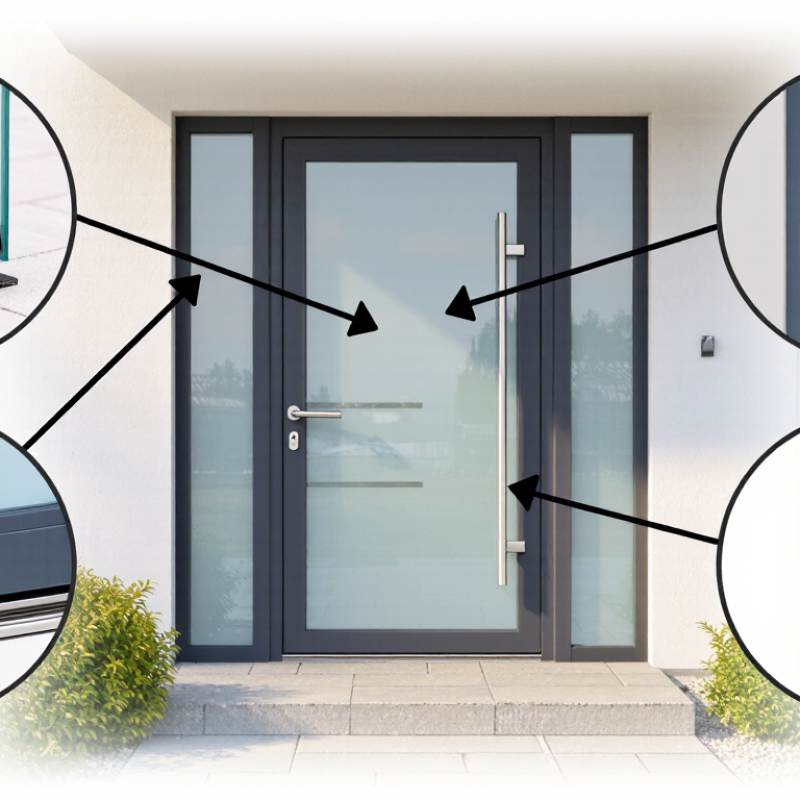
What Is the Best Aluminium Front Door in 2026?
Set the 2026 Benchmark: Whole-Door U-Value ≤1.0 W/m²K
The strongest aluminium front door in 2026 should be judged by its whole-door U-value, not its panel alone. A target of 1.0 W/m²K or lower indicates better resistance to heat loss. It should include the frame, leaf, glazing, threshold, and hardware. Product claims can look impressive. The calculation details matter more.
A well-designed door usually combines thermally broken aluminium profiles with insulated cores and low-emissivity glazing. The threshold deserves close attention. Cold metal at floor level can create discomfort, condensation, and higher heating demand. Ask for certified test results, declared dimensions, and the calculation method used. Laboratory figures may differ from performance on site.
Installation can quietly weaken excellent design. Gaps around the frame, poorly sealed corners, or a twisted opening may increase air leakage. Experienced installers check the wall opening before fitting the door. They also use continuous insulation and weather seals. Small errors matter.
U-value is not everything. Solar exposure, orientation, ventilation, and daily use affect real comfort. A lower number may still disappoint if the door leaks air. This benchmark is demanding, but it is practical. It encourages honest comparisons. It also leaves room for reflection: a perfect laboratory result cannot repair careless installation.
A strong aluminium front door starts with thermal design, not appearance. Thermally broken frames use an insulating polyamide barrier between the inner and outer aluminium sections. This interrupts the cold bridge and reduces heat transfer through the frame. For 2026 projects, a whole-door U-value of 1.4 W/m²K or lower is a sensible benchmark. The UK Government’s Approved Document L, 2021 edition, lists 1.4 W/m²K for many replacement doors. However, frame performance alone does not prove the complete door performs equally well.
Glass, seals, thresholds, and installation also matter. The International Energy Agency reported that buildings consume about 30% of global energy demand in its Buildings report. A poorly fitted door can undermine an excellent laboratory rating. Look for declared U-values tested under EN 14351-1, and check whether the figure covers the complete door set. A low threshold may improve access, but it can create a colder edge if its thermal break is weak. I would not treat 1.4 as a magic number. Real homes are less tidy than test chambers.
Tips: Ask for the frame, panel, glazing, and whole-door U-values separately. Check air leakage results and installation details. A thermal camera inspection on a cold morning can reveal unexpected edge losses. Also question vague claims such as “high performance”; measurable data is more useful. Performance depends on fitting quality, and that part is often underestimated.
A strong aluminium front door in 2026 should be judged by its complete security system, not its appearance alone. EN 1627 RC2 certification indicates resistance against common opportunistic attacks using basic tools. However, the rating must cover the complete door assembly, including the frame, hinges, lock, glazing, and installation. A certified lock fitted into an untested frame may create false confidence.
Multipoint locks improve stability by securing the door at several points along its height. Check whether the locking points engage smoothly without forcing the handle. Laminated glazing adds another layer of protection. Its bonded interlayer helps hold broken glass together, reducing dangerous shards and delaying forced entry. Ask for clear test documentation, not vague “high-security” language. I have seen attractive doors fail because the glass specification was overlooked. That detail is easy to miss.
Tips: Check the full EN 1627 certificate. Confirm the RC2 rating applies to the supplied size and configuration. Test the handle, cylinder, and locking points before signing off the installation. Look closely at the threshold and hinge side. Small gaps matter. Also, security is not only about resistance; poor fitting can weaken excellent materials. Recheck the door after seasonal movement, because aluminium frames can still reveal alignment problems.
Verify security with EN 1627 RC2 certification, a tested multipoint locking system, and laminated glazing documented for the complete doorset.
RC2 specifies 3 minutes of effective resistance during manual attack testing, within a 15-minute total test duration.
Confirm that the lock, cylinder, keeps, handles, and frame are included in the tested doorset evidence.
Check the glass classification, such as EN 356, and verify that the installed glazing matches the certified doorset configuration.
The strongest choice is an aluminium doorset with a current, independently verified EN 1627 RC2 classification. A multipoint lock or laminated glass alone does not prove RC2 performance; the complete door, frame, hardware, glazing, and installation configuration must be covered by the evidence.
What Is the Best Aluminium Front Door in 2026?
For a front door, weather sealing deserves more attention than surface finish. EN 12207 Class 4 sets a maximum reference air leakage of 3 m³/h·m² at 100 Pa. This is the highest air-permeability class under the standard. In practical terms, a correctly installed door should resist draughts around the frame and threshold. However, the laboratory result depends on the complete door set, not the aluminium slab alone. A poorly adjusted latch can spoil excellent factory data.
Water protection is tested under EN 12208. Class 9A represents exposure to 600 Pa for 15 minutes without water penetration. That pressure feels severe. Wind-driven rain can strike the lower corners, seals, and drainage channels first. I look closely at those areas during site inspections. The threshold should drain outward, while compression gaskets must meet evenly around the corners. Small gaps become obvious after heavy rain.
These classifications are useful evidence, not magic numbers. EN 12207 and EN 12208 test standards from CEN, while installation guidance from the European Aluminium Association stresses correct detailing and workmanship. A 2024 European Commission building-performance report also links airtight construction with lower energy demand, although doors are only one part of the envelope. I would request the full test report, including size, configuration, pressure stages, and installation conditions. A smaller test door may perform better than a larger entrance door. That difference is easy to miss.
| Evaluation dimension | Relevant standard or reference | Verified target or factual value | Why it matters for an aluminium front door | Assessment for a 2026 specification |
|---|---|---|---|---|
| Air permeability | EN 12207 | Class 4, the highest classification in EN 12207. The reference air permeability is up to 3 m³/(h·m²) at 100 Pa, with a maximum test pressure of 600 Pa. | Reduces uncontrolled draughts, dust entry and heat loss around the door leaf and frame. | Essential minimum target |
| Watertightness | EN 12208 | Class 9A, tested at 600 Pa with a minimum exposure period of 55 minutes under the standard classification sequence. | Provides strong resistance to wind-driven rain when the threshold, seals, drainage and installation are correctly designed. | Preferred high-performance target |
| Tested door configuration | EN 1026 and EN 1027 test procedures, classified under EN 12207 and EN 12208 | The reported classification should apply to the complete door assembly, not only to an isolated frame or seal sample. | Glass, panels, hinges, locks, threshold and junctions can affect the final result. | Require a complete-assembly test report |
| Weather seals | Product design criterion supporting EN 12207 and EN 12208 performance | Continuous compression seals at the head, jambs and threshold, with corners properly joined and compressed after installation. | Gaps, poorly joined corners or insufficient compression can reduce air and water performance. | Inspect before approval |
| Threshold and drainage | EN 12208 water-tightness test principles | A weathered threshold should include a reliable drainage path, unobstructed outlets and compatible seals. | The threshold is commonly exposed to splash water and is a critical part of the 9A performance. | High priority inspection point |
| Thermal separation | EN ISO 10077-1 and EN ISO 10077-2 | Use a thermally broken aluminium frame and thermally insulated leaf; thermal performance must be calculated for the actual configuration. | Aluminium is highly conductive, so thermal breaks help reduce heat transfer and internal condensation risk. | Recommended for energy efficiency |
| Hardware adjustment | Installation and product-maintenance requirement | Multi-point locking hardware must pull the leaf evenly against the seals without excessive force or visible gaps. | Incorrect adjustment can cause air leakage and water penetration even when the door design has passed laboratory testing. | Check after installation |
| Installation quality | EN 12207 and EN 12208 classifications relate to the tested product configuration | The surrounding wall joint should be sealed continuously, correctly packed and protected from moisture; site conditions may differ from laboratory results. | A high-performing door can fail in service if the frame-to-wall connection is poorly sealed or distorted. | As important as the door itself |
| Evidence to request | Test documentation for the specified door size and configuration | Request the classification, test standards, specimen size, opening direction, glazing or panel type, threshold design and test date. | Performance values are only comparable when the tested configuration matches the proposed installation. | Mandatory before purchase |
What Is the Best Aluminium Front Door in 2026?
The best aluminium front door should be judged by circularity, not appearance alone. Recycled aluminium uses about 5% of the energy required for primary aluminium production, according to the International Aluminium Institute. That means roughly 95% less energy during remelting. The benefit is significant when old frames return to controlled recycling systems.
Look for verified recycled content, durable powder coating, and a thermally broken frame. A thermal break reduces heat transfer through the metal, especially around the threshold on cold mornings. The European Aluminium industry reports that aluminium can be recycled repeatedly without losing its core material properties. However, recycled content does not guarantee a low-carbon door. Electricity sources, transport, coatings, glass, and installation still influence its footprint. This is where many product claims feel incomplete. An Environmental Product Declaration can offer better evidence than a simple “eco” label.
Tips: Ask for the recycled-content percentage and its certification. Check the door’s whole-unit U-value, not only the panel. Confirm that seals and hardware can be replaced. A slightly heavier door may feel more stable, but poor installation can waste its thermal performance. Request take-back or recycling guidance before ordering. Industry data helps, but site details still matter.
Aim for 1.0 W/m²K or lower. The figure must include the frame, leaf, glazing, threshold, and hardware. Panel-only data can mislead.
Thermally broken aluminium profiles, insulated cores, and low-emissivity glazing usually improve performance. The threshold matters too. Cold metal can create discomfort and condensation.
The threshold sits near floor level and faces rain, draughts, and temperature changes. It should drain outward and connect continuously with the insulation.
EN 12207 Class 4 is a strong reference point. It indicates maximum air leakage of 3 m³/h·m² at 100 Pa. Installation still matters.
EN 12208 Class 9A indicates resistance at 600 Pa for 15 minutes without water penetration. Lower corners, seals, and drainage channels need close inspection.
No. Laboratory figures may use smaller doors and controlled conditions. A larger entrance door may perform differently. That detail is easy to miss.
Gaps, twisted openings, weak corner seals, or a poorly adjusted latch can increase draughts. Installers should inspect the wall opening before fitting.
No. Orientation, sunlight, ventilation, daily use, and air leakage also affect comfort. A lower number can still disappoint. Numbers are not the whole story.
Choosing the best Aluminium Front Door in 2026 requires more than evaluating appearance and price. The strongest benchmark is a whole-door U-value of 1.0 W/m²K or lower, helping reduce heat loss across the complete entrance rather than focusing only on the glass or frame. Thermally broken frames should also be assessed, with a target frame U-value of 1.4 W/m²K or better. These figures provide a practical way to compare energy performance and long-term comfort.
Security and weather resistance are equally important. Look for EN 1627 RC2-rated protection, reliable multipoint locking, and laminated glazing for added resistance. Effective seals should achieve EN 12207 Class 4 for air permeability and EN 12208 Class 9A for watertightness. Finally, review the door’s environmental credentials, including its aluminium content and recyclability. Recycled aluminium requires approximately 5% of the energy used for primary production, making it a valuable part of a more circular, lower-impact door choice.