0%

Choosing the right Aluminum Entrance Door is more than comparing colors and prices. It shapes your home’s security, comfort, and first impression. A dependable choice should match your climate, wall structure, daily traffic, and architectural style.

Experienced installers usually examine the frame depth, thermal break, glass specification, seals, hinges, and locking system. These details affect heat transfer, noise, water resistance, and long-term operation. In a rainy area, effective drainage and tightly fitted gaskets matter greatly. In a hot climate, a quality powder-coated finish can help resist fading and surface wear.

Look beyond appearance.

Measure the opening carefully. Even a well-made door may perform poorly when the surrounding structure is uneven or weak. Ask manufacturers for tested performance data, warranty terms, maintenance instructions, and information about replacement hardware. Reliable suppliers should explain these points clearly instead of making vague claims.

A good Aluminum Entrance Door should open smoothly, close firmly, and remain stable after repeated use. Check whether the handle feels solid and whether the threshold supports safe access. Small details often reveal product quality.

There is no perfect door for every property. I have found that attractive designs can sometimes compromise insulation or practical maintenance. That trade-off deserves honest consideration. The best selection balances appearance, performance, installation quality, and future repair needs. This guide will help you compare those factors with greater confidence and avoid decisions based only on showroom appeal.
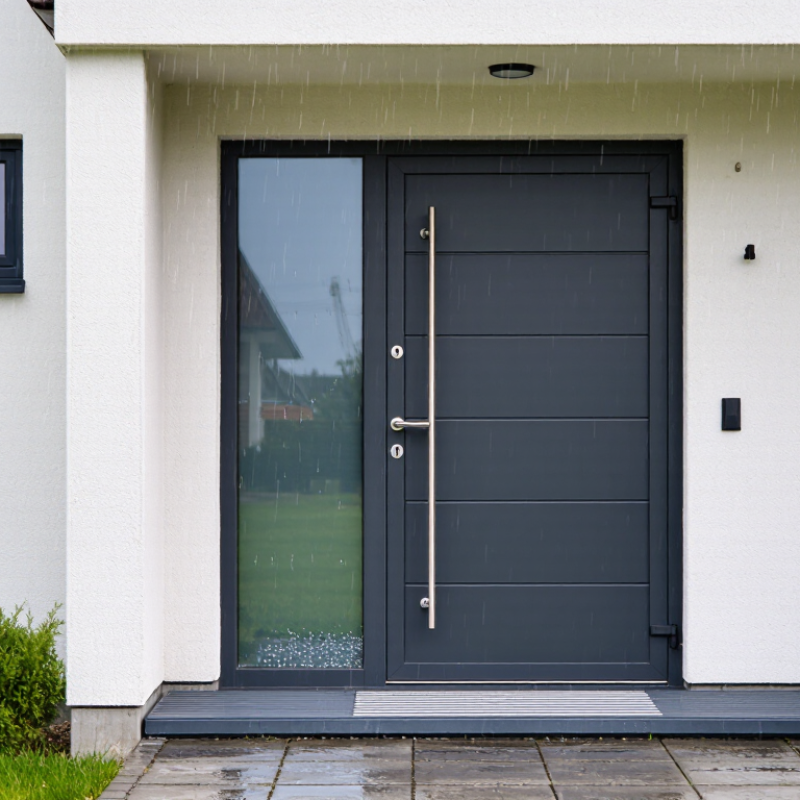
How to Choose the Best Aluminum Entrance Door?

Define Performance Needs and Entrance Conditions

Choosing an aluminum entrance door starts with performance needs, not appearance. The U.S. Department of Energy reports that heating and cooling use about 48% of energy in a typical U.S. home. A poorly sealed entrance can increase that burden. Define the required U-factor, air leakage, water resistance, and structural rating before selecting a profile. NFRC rating procedures provide useful data for U-factor, solar heat gain, and air leakage. These figures help compare tested products objectively.

Entrance conditions matter just as much. A south-facing doorway may receive strong afternoon heat. A coastal opening may face salt air and wind-driven rain. Freeze-thaw cycles can damage weak thresholds and poorly drained frames. Specify a thermal break for cold climates, insulated glazing for exposed entries, and corrosion-resistant finishes near marine environments. ASTM and AAMA test methods can help verify water penetration and operating performance. Field inspections often reveal small problems, such as an uneven sill or compressed weatherstripping. Details matter more than expected.

Tips: Measure the rough opening twice. Check drainage paths before installation. Confirm the door swing, traffic level, and accessibility requirements. Ask for test reports, not vague performance claims. A lower U-factor is helpful, but it may not solve solar overheating. Review the whole entrance system, including glass, frame, hardware, seals, and threshold. Perfect specifications are uncommon; reconsider them after observing the actual site.

Compare Aluminum Door Constructions and Opening Styles

How to Choose the Best Aluminum Entrance Door?

Aluminum entrance doors come in different constructions, and the frame design affects comfort, strength, and maintenance. Thermally broken frames include an insulating strip between the interior and exterior aluminum sections. This reduces heat transfer near the doorway. Non-thermal frames cost less, but they may feel cold during winter and collect condensation in humid rooms. For exposed entrances, look for reinforced profiles, insulated panels, compression seals, and corrosion-resistant finishes. The door should also include a properly supported threshold. A weak threshold can allow water beneath the frame.

Opening style changes how the entrance works every day. Hinged doors suit most homes and provide a familiar, secure seal. Inward openings save exterior clearance, while outward openings can protect interior space. Sliding doors create wide access and work well beside patios, but their tracks need regular cleaning. They may also provide a less airtight seal than hinged designs. Pivot doors offer a dramatic appearance and handle large panels, yet their hardware demands accurate installation. Measure furniture paths, nearby walls, and the swing area before choosing.

I have seen attractive doors fail because the opening direction was ignored. Small details matter. Ask the installer about air leakage, water resistance, wind load, and local safety requirements. A low threshold helps accessibility, but it may need extra drainage in rainy locations. Glass choice also changes weight and energy performance. I would not select a door from photographs alone. Check sample corners, gasket contact, hardware movement, and frame alignment in person. Even experienced buyers can overlook the morning sun.

Evaluate Thermal, Weather, Security, and Acoustic Performance

How to Choose the Best Aluminum Entrance Door?

An aluminum entrance door should be judged by measured performance, not appearance alone. Thermal efficiency begins with the frame, glass, and threshold. Choose thermally broken aluminum profiles and insulated cores. Check the certified U-factor. Lower values indicate better resistance to heat transfer.

The U.S. Department of Energy reports that windows can cause 25–30% of residential heating and cooling energy use. A door is not a window, but weak seals can still create a cold hallway and visible condensation.

Weather performance needs equal attention. Look for tested air leakage, water penetration, and wind resistance under recognized standards, such as ASTM or EN procedures. A quality door should close evenly, without forcing the handle. Inspect the bottom seal carefully. Small gaps matter.

Security depends on more than a multi-point lock. The European standard EN 1627 evaluates resistance classes using defined attack methods, offering a clearer comparison than vague “high security” claims. Yet installation remains a common weakness.

Even a strong leaf can fail when anchors are shallow or the surrounding wall is unstable.

Acoustic performance is often overlooked near roads or apartment corridors. Ask for laboratory sound-reduction data, such as Rw or STC, rather than marketing language. The World Health Organization recommends less than 30 dB(A) indoors at night for good sleep conditions. This target may be unrealistic beside heavy traffic.

Weather seals, laminated glass, and a tight threshold can still reduce noticeable noise. Request the full test report, including frequency ranges.

One uncomfortable truth remains: laboratory results may not match a poorly installed door.

Review Dimensions, Finishes, Hardware, and Customization Options

How to Choose the Best Aluminum Entrance Door?

Dimensions should be measured from the structural opening, not the old frame. Check width, height, sill depth, wall thickness, and swing clearance. A small measurement error can create uneven gaps and costly site adjustments. Ask for verified U-factor, air leakage, and solar heat gain data. The National Fenestration Rating Council explains that these ratings help compare thermal performance consistently. The U.S. Energy Information Administration’s 2020 Residential Energy Consumption Survey reports that space heating used about 42% of household energy. A poorly sealed entrance door cannot solve that problem, but it can worsen drafts and comfort.

Finishes must suit climate and maintenance expectations. Powder-coated surfaces resist daily wear, yet color fading still depends on sunlight and coating quality. Request performance documentation, such as coating specifications aligned with AAMA standards. Hardware deserves equal attention. Use adjustable hinges, a weather-resistant threshold, and a multi-point locking system when security and sealing matter. Glass panels should include safety glazing and suitable low-emissivity performance. Custom options may include sidelights, transoms, concealed closers, access controls, and unusual opening sizes. More features are not always better.

Tips: Compare the complete door system, not only the slab. Confirm drainage paths, replacement parts, warranty limits, and installation tolerances. I would also test the sample finish outdoors before ordering. It may look different indoors. Recheck every dimension after flooring and cladding are finalized. No selection is perfect.

How to Choose the Best Aluminum Entrance Door? — Dimensions, Finishes, Hardware, and Customization Options

Selection Area Option or Specification Typical Range or Standard Best Use or Benefit Important Considerations
Door Configuration Single entrance door Common nominal widths: 800–1000 mm
Common heights: 2000–2400 mm
Confirm the rough opening, frame dimensions, threshold height, and required clearance before ordering.
Door Configuration Wide single door Approximately 1000–1200 mm wide Creates a more spacious entrance and improves furniture or equipment access. A wider leaf may require stronger hinges, a reinforced frame, and careful review of wind loads.
Door Configuration Double entrance door Total opening width commonly 1400–2000 mm Useful for large entrances, hospitality spaces, offices, and high-traffic areas. Choose the active leaf, inactive leaf, meeting stile, astragal, and security locking arrangement.
Door Configuration Door with sidelights Typical sidelight widths: 200–600 mm per side Adds daylight and increases the visual width of the entrance. Use safety-rated glazing where required, especially near the door handle and low-level areas.
Door Configuration Door with transom Typical transom height: 300–900 mm Provides additional daylight above the door without increasing the door leaf height. Consider fixed, operable, glazed, or insulated transom designs according to ventilation and energy needs.
Dimensions Rough opening measurement Measure width, height, depth, and diagonals at several points Helps prevent installation problems caused by uneven or out-of-square openings. Do not rely on a single measurement; masonry, flooring, and finished wall conditions can change the required size.
Dimensions Frame depth Common systems range approximately from 50–150 mm Allows the frame to match wall thickness and installation conditions. Verify compatibility with insulation, cladding, plaster, brickwork, or other surrounding finishes.
Dimensions Threshold type Standard, low-profile, thermal-break, or accessible threshold Balances weather protection, energy performance, and ease of passage. Accessibility requirements may limit the allowable threshold height; drainage and water management are also important.
Material and Performance Aluminum profile with thermal break Polyamide or similar insulating barrier between interior and exterior aluminum sections Overall performance depends on the complete door assembly, glazing, gaskets, threshold, and installation quality.
Material and Performance Non-thermal-break aluminum profile Continuous aluminum frame without an insulating separator Often suitable for mild climates, interior applications, garages, or budget-conscious projects. Generally offers lower thermal performance and may be more prone to condensation in cold conditions.
Glazing Clear insulated glass unit Commonly double glazing; thickness and cavity vary by system Improves daylight, thermal insulation, and sound reduction compared with single glazing. Ask for the complete glass make-up, including pane thickness, spacer, cavity, coatings, and safety classification.
Glazing Low-emissivity glass Coated glass designed to reduce radiant heat transfer Can improve energy efficiency while maintaining natural light. Solar-control and low-emissivity coatings have different effects; select them according to climate and orientation.
Glazing Laminated or tempered safety glass Use where impact safety, security, or local building codes require it Improves safety in door leaves, sidelights, and transoms. Check applicable safety-glazing rules for glass located near floors, handles, stairs, or walking surfaces.
Finishes Powder-coated finish Available in many solid, textured, and metallic colors Color appearance can vary by batch, texture, viewing angle, and lighting; request a physical sample when appearance is critical.
Finishes Anodized finish Common appearances include natural, clear, bronze, and darker metallic tones Preserves a metallic aluminum appearance and provides a hard surface layer. Anodized color consistency may vary between production batches and extrusions.
Finishes Wood-effect finish Decorative transfer or sublimation finish over aluminum Combines the visual character of wood with the dimensional stability of aluminum. Inspect the grain direction, corner treatment, texture, and color consistency before approval.
Finishes Exterior/interior dual-color finish Different colors or finishes on the two sides of the door Allows the exterior to match the facade while the interior matches the room design. Confirm whether the frame, sash, glazing beads, threshold, and hardware are included in the color specification.
Hardware Lever handle set Available in straight, curved, pull-lever, and return-to-door styles Offers convenient everyday operation and can support accessible-use requirements. Choose a corrosion-resistant material and verify backset, spindle size, handing, and compatibility with the lock body.
Hardware Pull handle Available in short, full-height, round, square, or rectangular profiles Creates a strong visual feature and is well suited to modern entrance designs. Check fixing points, handle projection, structural reinforcement, and clearance from adjacent walls or glazing.
Hardware Multi-point locking system Commonly locks at several points along the door edge Ensure the lock, cylinder, keeps, handle, and door profile are designed to work together.
Hardware Euro-profile or comparable cylinder Choose cylinder length according to door thickness, escutcheon, and handle arrangement Supports keyed, thumb-turn, restricted-key, or electronic access configurations. The cylinder should not project excessively beyond the escutcheon because excessive projection can increase tampering risk.
Hardware Door closer Surface-mounted, concealed, or floor-mounted options Controls closing speed and helps ensure the door closes reliably. Select capacity based on door width, weight, wind exposure, usage frequency, and accessibility requirements.
Hardware Hinges Visible, concealed, adjustable, or heavy-duty hinge designs Supports smooth operation and allows alignment adjustments during installation. Verify the hinge load rating, number of hinges, adjustment range, corrosion resistance, and door handing.
Security Security cylinder and escutcheon Options may include anti-drill, anti-pick, anti-bump, and anti-pull features Provides additional protection around the primary locking component. Security hardware should be selected as part of a complete tested door and locking assembly.
Weather Protection Perimeter gaskets and seals Replaceable EPDM or comparable weather seals are commonly used Reduces air leakage, water penetration, and noise around the door perimeter. Seals must meet evenly at the corners and remain compatible with the selected frame, glazing, and threshold.
Weather Protection Drip bar or sill protection Optional depending on threshold and exposure Helps direct rainwater away from the bottom of the door. Correct exterior drainage, sill slope, flashing, and sealant detailing are essential for weather performance.
Customization Panel design Full glass, half glass, solid panel, horizontal divisions, or decorative inserts Allows the door to balance privacy, daylight, security, and architectural style. Panel joints and inserts should be sealed and mechanically secured according to the door system requirements.
Customization Privacy glass Frosted, satin, patterned, tinted, or obscured glass Improves privacy while still allowing diffused daylight. Different patterns provide different levels of privacy; review a sample at the intended viewing distance.
Customization Insect screen or secondary screen door Sliding, hinged, retractable, or removable designs Improves ventilation while helping keep insects outside. Confirm that the screen does not interfere with the main door, handle projection, threshold, or emergency egress.
Customization Access control preparation Electric strike, motorized lock, keypad, card reader, intercom, or smart-home wiring Supports controlled entry and future security upgrades. Plan power supply, cable routes, fail-safe or fail-secure behavior, manual override, and emergency exit requirements.
Maintenance Routine cleaning Use mild detergent, clean water, and a soft cloth Helps preserve the finish and prevents dirt buildup around seals and drainage paths. Avoid abrasive pads, strong solvents, chloride-based cleaners, and unapproved chemicals.
Maintenance Hardware adjustment and lubrication Inspect periodically, especially in high-use or coastal locations Maintains smooth operation, alignment, and locking performance. Use only lubricants recommended for the specific lock, hinge, closer, and cylinder components.
Final Selection Recommended specification checklist Confirm dimensions, opening direction, thermal performance, glazing, finish, hardware, security, drainage, and installation details Review the final shop drawing and product schedule before fabrication; local building, fire, accessibility, and energy codes take priority.

Note: Dimensions and specifications shown are typical planning ranges. Final requirements should be verified against the selected door system, project drawings, site conditions, and applicable local regulations.

Verify Installation Requirements, Compliance, Warranty, and Total Cost

An aluminum entrance door should be chosen as a tested assembly, not a shiny slab. Before ordering, measure the rough opening at three points. Record width, height, sill level, wall thickness, drainage path, and swing clearance. A two-millimeter error can become a costly site adjustment. Ask for the product’s NFRC label, U-factor, solar heat gain coefficient, air leakage, and visible transmittance. These figures allow a fair comparison. EIA’s 2020 Residential Energy Consumption Survey, published in 2023, attributes 42% of household energy use to space heating. Thermal performance deserves attention, even in an entry hall.

Check the locally adopted building code before selecting hardware or glazing. The 2024 IECC uses climate-specific fenestration limits, so a compliant door in one city may fail elsewhere. Confirm structural, water, air, fire, accessibility, and emergency-egress requirements where applicable. Ask for test reports, not marketing adjectives. Warranty language matters. Read coverage for finish, glass, hardware, labor, and site-related exclusions. Some warranties transfer; others end when the property changes hands. Keep installation instructions and signed records.

Compare total installed cost, not only the door price. Include delivery, flashing, sill pan, sealants, trim, removal, disposal, and future adjustment. An inexpensive quote may omit sill preparation or water management. RICS’s 2023 Whole Life Carbon Assessment guidance supports evaluating products across manufacture, replacement, and end-of-life stages. Aluminum can be durable, but poor thermal breaks or careless sealing can erase that advantage. Ask who corrects a leak. No checklist is flawless. Recheck dimensions before payment.

FAQS

What thermal features should an aluminum entrance door have?

Choose thermally broken profiles, insulated cores, and low certified U-factor values. Weak seals can create a cold hallway. Condensation may still appear.

How can I check weather resistance?

Request tested air leakage, water penetration, and wind resistance results. Inspect the bottom seal closely. Small gaps matter.

Does a multi-point lock guarantee strong security?

No. Security also depends on the frame, anchors, surrounding wall, and installation quality. Shallow anchors can weaken a strong door. That detail is easy to miss.

How should acoustic performance be compared?

Ask for laboratory sound-reduction data, such as a recognized rating. Request frequency details, not vague promises. Laminated glass and tight seals can reduce road noise.

What measurements should I take before ordering?

Measure the rough opening at three points. Record width, height, sill level, wall thickness, drainage, and swing clearance. A two-millimeter error can cause costly adjustments.

Which compliance documents should I request?

Ask for reports covering thermal, water, air, structural, fire, accessibility, and emergency requirements. Local rules may differ by climate. One test is never enough.

What should an entrance-door warranty include?

Check coverage for finish, glass, hardware, labor, and installation-related exclusions. Confirm whether the warranty transfers after a property sale. Keep every signed record.

How do I compare the real cost of different doors?

Include delivery, flashing, sill preparation, sealants, trim, removal, disposal, and future adjustments. A low quote may omit water-management work. Recheck everything before payment.

Conclusion

Choosing the best Aluminum Entrance Door begins with understanding the building’s entrance conditions and performance needs. Consider exposure to rain, wind, sunlight, temperature changes, traffic frequency, and the level of security required. Then compare suitable door constructions and opening styles, such as hinged, sliding, or double-door configurations, based on available space and daily use. Pay close attention to thermal insulation, weather resistance, sound reduction, durability, and locking performance to ensure long-term comfort and protection.

Next, confirm the required dimensions, surface finishes, glazing options, hardware, colors, and other customization details. Installation requirements should be reviewed early, including wall conditions, drainage, threshold design, and preparation for electrical or access-control components when applicable. Finally, check compliance documentation, warranty coverage, maintenance expectations, delivery terms, and the total cost over the door’s service life. A well-balanced decision will provide an Aluminum Entrance Door that matches the building’s appearance while delivering reliable performance, security, and value.

Evelyn

Evelyn

Evelyn is a professional marketing specialist with in-depth knowledge of the company’s products and a strong commitment to clear, useful communication. She regularly contributes expert blog articles to the company website, helping readers understand product features, practical applications, and......