Choosing a Luxury Aluminum Entry Door involves more than admiring a dramatic finish or oversized glass panel. The right door should suit your architecture, climate, security needs, and daily routines. A reliable evaluation begins with the aluminum grade, frame construction, thermal break, glazing, hinges, locks, and surface coating. Details matter.
In real projects, small differences become obvious after installation. A poorly measured frame may create uneven gaps. Weak hardware can make a heavy door feel rough or unstable. A durable powder-coated finish should resist fading, moisture, and frequent contact, but no coating remains perfect forever. That is worth remembering. Ask manufacturers for technical specifications, warranty terms, finish samples, and evidence of product testing. Independent certifications can also support claims about strength, insulation, air leakage, and water resistance.
Style still matters. Clean lines may complement a modern façade, while textured panels can soften a large entrance. Consider how afternoon sunlight changes the color and how the handle feels with wet hands. Think about delivery access, threshold height, drainage, and professional installation before placing an order. Measure twice.
An experienced installer can identify problems that product photographs hide. They should confirm wall conditions, opening dimensions, weather sealing, and hardware alignment. There is no flawless choice. A premium door can still disappoint when its design ignores the building around it. This guide explains how to compare materials, performance, customization, maintenance, and long-term value before selecting a Luxury Aluminum Entry Door with confidence.
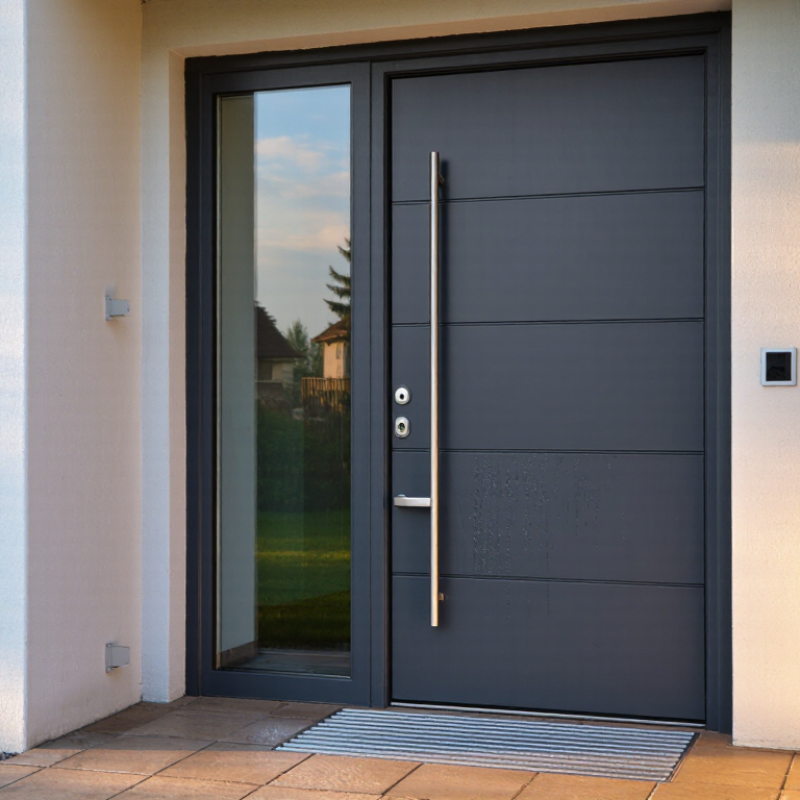
Before comparing finishes, define what your entryway must accomplish. Measure the rough opening, wall depth, swing clearance, and threshold height. A beautiful door can still fail if furniture blocks its arc. Note the weather exposure too. A west-facing entrance may receive harsh afternoon heat, while a covered porch needs less shading. Write three priorities, not ten: security, insulation, daylight, quiet, or visual impact. Be honest about trade-offs. More glass may brighten the hall, but it can reduce privacy.
For a luxury aluminum entry door, ask how the frame manages heat transfer. Look for a tested thermal break, durable seals, and performance data suited to your climate. In wet or coastal areas, confirm that the finish and hardware resist corrosion. Do not rely on showroom weight alone. Check hinge capacity, lock quality, drainage, and replacement access. Precise installation matters as much as the door. The installer should verify plumb, level, and square before final fastening. Small errors can create drafts or uneven gaps. I have seen elegant projects weakened by rushed threshold work. That detail is easy to overlook.
Set a practical budget that includes delivery, structural adjustments, glazing, and installation. Request written specifications, warranty terms, and maintenance instructions. Ask who handles service if a seal fails. Clear answers build confidence. Still, do not chase perfection. A matte surface may show fingerprints, and a large handle may feel awkward with wet hands. Visit a completed installation if possible. Stand inside it. Listen for street noise, test the latch, and view the daylight at different hours. Your priorities should feel right in daily use, not only in photographs.
A luxury aluminum entry door should begin with its alloy, not its decoration. For many residential applications, 6063 aluminum offers clean extrusion lines and a smooth surface. It suits detailed frames and refined profiles. 6061 aluminum provides higher structural strength, especially for large openings or heavier panels. However, stronger does not always mean better. The frame must match the building’s size, glass weight, and local weather.
Finish quality becomes obvious in changing light. Anodizing preserves the metal’s texture and resists peeling, while powder coating offers broader color choices. Ask about coating thickness, surface preparation, and testing standards. A beautiful sample can hide weak preparation. I have seen small scratches reveal inconsistent finishing beneath bright showroom lights. Dark colors also absorb more heat, which may increase movement in hot climates. This detail is easy to overlook.
Construction quality controls daily performance. Look for thermal breaks, continuous weather seals, reinforced corners, and accurately fitted hinges. A multi-point lock should engage smoothly without forcing the handle. Drainage paths should move water away from the interior, not into the threshold. Check the door’s air, water, and wind-performance reports when available. Good installation matters just as much. Even a well-made frame can leak if the sill is uneven or the surrounding wall shifts. A heavier door is not automatically more secure. Precise joints, stable hardware, and careful fitting usually matter more.
| Evaluation Dimension | Option or Specification | Key Characteristics | Advantages | Limitations and Selection Notes | Best Application |
|---|---|---|---|---|---|
| Aluminum Grade | 6063-T5 or 6063-T6 | Common architectural alloy with good corrosion resistance, smooth extrusion surfaces, and strong suitability for complex profiles. | Excellent appearance after anodizing or powder coating; easy to extrude into narrow sightlines and decorative shapes. | Generally has lower mechanical strength than 6061. Confirm the temper and the supplier's published structural data rather than judging by alloy number alone. | Architectural door frames, decorative profiles, and designs where surface quality and profile complexity are priorities. |
| Aluminum Grade | 6061-T6 | Heat-treated structural aluminum alloy with higher strength than typical 6063 profiles. | Useful for reinforced members, large openings, heavy door leaves, and areas requiring greater resistance to bending. | Usually more difficult to extrude into highly intricate shapes, and the surface may be less optimized for decorative architectural finishes than 6063. | Large-format doors, structural reinforcement, pivot-door components, and high-load applications. |
| Aluminum Grade | Alloy and temper verified by documentation | The alloy identifies the material family, while the temper indicates heat-treatment and mechanical-property condition. | Helps buyers compare products using traceable technical information instead of appearance or marketing terminology. | Ask for material specifications, profile dimensions, wall thickness, and applicable test data. “Aerospace grade” or “premium aluminum” alone is not a precise specification. | Any luxury entry door where long-term durability and structural performance matter. |
| Thermal Construction | Thermally broken frame | A low-conductivity polyamide or similar separator reduces direct metal-to-metal heat transfer through the frame. | Improves thermal efficiency and reduces the risk of interior condensation compared with a continuous aluminum frame. | Performance depends on the complete door assembly, including glass, panel, seals, threshold, installation, and drainage details. | Conditioned homes, cold or hot climates, and entrances where interior comfort is important. |
| Thermal Construction | Non-thermally broken frame | The interior and exterior aluminum surfaces remain directly connected through the frame. | Can provide a simpler design and may be suitable for mild climates or unconditioned spaces. | Transfers heat more readily and may increase condensation risk in humid or cold conditions. It is usually less suitable for high-performance residential applications. | Mild climates, interior partitions, secondary entrances, or projects with limited thermal requirements. |
| Surface Finish | Anodized aluminum | An electrochemical process creates an integral oxide layer that can provide a metallic appearance. | Retains a natural aluminum character, resists flaking because the finish is integral to the surface, and requires relatively simple maintenance. | Color range is more limited than powder coating; shade variation can occur between production batches and extrusions. Scratches can be difficult to repair invisibly. | Modern and minimalist entrances that favor visible metallic grain and a restrained color palette. |
| Surface Finish | Exterior-grade powder coating | Dry powder is electrostatically applied and cured to form a colored protective coating. | Offers a broad range of colors and gloss levels, with a uniform appearance and good resistance to normal weather exposure when properly specified. | Confirm that the coating is intended for exterior architectural use and ask about pretreatment, film thickness, color retention, and warranty terms. | Contemporary homes requiring custom colors, dark finishes, or coordinated exterior design. |
| Surface Finish | PVDF-based architectural coating | A factory-applied high-performance coating system designed for demanding exterior exposure. | Typically provides strong resistance to ultraviolet exposure, weathering, and color change when correctly formulated and applied. | Often costs more than standard powder coating. Verify the actual coating chemistry, number of coats, pretreatment, and project-specific performance documentation. | High-sunlight locations, coastal or demanding environments, and premium projects emphasizing long-term appearance. |
| Frame Construction | Multi-chamber reinforced frame | Uses engineered cavities, reinforced zones, and carefully designed profiles to balance strength, thermal performance, and weight. | Can improve rigidity and support larger door sizes while accommodating thermal breaks, gaskets, and hardware. | Chamber count alone does not prove quality. Review profile dimensions, reinforcement, corner joints, and tested assembly performance. | Large residential entry doors and high-end projects with demanding size and comfort requirements. |
| Corner Construction | Mechanically fastened and sealed corners | Profiles are joined with screws, brackets, sealants, or crimped connections, depending on the system design. | Can provide consistent assembly when joints are accurately fabricated and properly sealed. | Inspect joint alignment, fastener quality, sealant continuity, and drainage paths. Poor fabrication can cause air or water leakage regardless of alloy grade. | Most aluminum door systems, provided fabrication quality is controlled. |
| Weather Resistance | Continuous compression gaskets | Replaceable elastomeric seals compress against the frame and door leaf to limit air and water infiltration. | Supports weather resistance and can reduce drafts, noise transmission, and rattling. | Gaskets must meet correctly at corners and remain flexible over time. Ask whether replacement profiles are available. | Exterior entrances exposed to wind-driven rain, temperature changes, or heavy daily use. |
| Threshold Design | Thermally improved, drained threshold | Combines insulation features with channels that direct incidental water toward the exterior. | Helps improve under-door comfort and supports water management when correctly installed. | Threshold height, accessibility requirements, sill pan design, and site drainage must be evaluated together. No threshold can compensate for incorrect installation. | Exterior doors in exposed locations and energy-conscious residential projects. |
| Hardware Capacity | Load-rated hinges or pivot hardware | Hardware is selected according to door-leaf weight, dimensions, operating frequency, and opening direction. | Improves smooth operation, alignment, and long-term serviceability for large or heavy doors. | Confirm the published weight rating, adjustment range, corrosion resistance, and availability of replacement parts. | Oversized pivot doors, thick insulated panels, and high-use main entrances. |
| Glass and Panel Quality | Insulated safety glazing or insulated door panel | May combine tempered or laminated safety glass with an insulating air or gas space, or use a thermally improved opaque panel. | Can improve safety, sound control, and thermal performance compared with single uninsulated glazing. | Overall performance depends on spacer design, edge seals, panel thickness, and the relationship between the glass or panel and the frame. | Glazed luxury entrances, street-facing homes, and doors requiring improved comfort or security. |
| Quality Verification | Whole-assembly test data | Performance is evaluated for the complete door system rather than for the aluminum profile alone. | Provides more meaningful information about air leakage, water resistance, structural loading, operation, and thermal behavior. | Test results should match the proposed configuration, size, glass or panel type, hardware, and installation method. | Any project where measurable performance is more important than appearance alone. |
A luxury aluminum entry door should protect comfort, privacy, and the building envelope. Thermal performance deserves careful inspection, not just a low U-value on a brochure. Ask for tested whole-door results, including the frame, glass, seals, and threshold. A thermally broken frame reduces conductive heat transfer. On a cold morning, weak detailing may still produce a chilly interior edge or condensation.
Security is more than a heavy appearance. Look for a reinforced frame, multi-point locking, laminated or toughened glass, and hinges protected from forced removal. Request evidence from recognized independent testing bodies. Confirm the cylinder resists picking, drilling, and unauthorized duplication. Installation matters equally. A strong door can underperform when anchors are sparse or the wall opening is uneven.
Tips: Stand inside on a windy day and inspect the seal line with a thin strip of paper. It should hold firmly when the door closes. Check weather ratings for air leakage, water penetration, and wind pressure. Do not trust vague terms like “all-weather.” Ask how the threshold manages driving rain and drainage. Small details matter. I would also request maintenance guidance for gaskets, hardware, and finishes. Even premium doors need adjustment after settling; ignoring that is an easy mistake.
Match the door style to the home’s architectural rhythm. A slim, full-height door suits contemporary façades with large glass planes. A paneled design feels more natural beside traditional masonry. For Mediterranean or transitional homes, warm-toned aluminum can soften strong geometry. Measure sightlines carefully. A beautiful door can still look wrong when its rails ignore nearby windows.
Glass selection affects privacy, daylight, and energy performance. The U.S. Department of Energy states that windows can account for 25–30% of residential heating and cooling energy use. Choose low-emissivity glass, insulated units, and a solar heat gain coefficient suited to your climate. Clear glass may brighten a shaded entrance, while fluted or textured glass blurs movement at night. Hardware should repeat existing finishes, not compete with them. Long pulls emphasize height; compact levers feel quieter. NFRC ratings help compare U-factor and solar heat gain objectively. The U.S. Energy Information Administration’s 2020 Residential Energy Consumption Survey reported that space heating represented 42% of household energy consumption. That makes thermal detailing worth serious attention. I would not rely on appearance alone. Even premium aluminum can feel cold if installation gaps remain untreated. A slightly imperfect design choice is easier to revise than poor flashing, weak weather seals, or hardware that becomes uncomfortable after years of daily use.
A luxury aluminum entry door should be measured at the finished opening, not guessed from an old door slab. Request width, height, wall thickness, sill height, swing direction, and threshold details in writing. A few millimeters can create uneven reveals, latch problems, or water entry. NFRC ratings help compare U-factor, solar heat gain coefficient, and visible transmittance, especially when the door includes large glass panels. The U.S. Department of Energy reports that windows and skylights can account for 25–30% of residential heating and cooling energy use, so glazing and frame design deserve equal attention.
Installation quality matters just as much. Ask whether the crew follows ASTM E2112 guidance for exterior doors and uses a compatible sill pan, flashing, sealant, and drainage path. FGIA installation practices also emphasize a continuous weather barrier connection.
Watch the threshold. It should sit level, remain firmly supported, and drain outward without blocking the weep path. A beautiful door cannot correct poor preparation.
Read the warranty before payment. Confirm coverage periods for finish, glass, hardware, structural parts, and labor. Ask which maintenance actions preserve coverage. Powder-coated aluminum usually needs gentle cleaning with mild soap and water; abrasive pads can damage the surface. Inspect seals, hinges, locks, and drainage channels twice yearly. Small issues are cheaper to repair. I would still request every promise in the contract, because verbal assurances are easy to misunderstand.
Measure the rough opening, wall depth, swing clearance, and threshold height. Check whether furniture blocks the door arc. Small errors matter.
Choose three priorities, such as security, insulation, daylight, quiet, or visual impact. More glass brightens a hall but may reduce privacy. Trade-offs are real.
6063 aluminum offers clean extrusion lines and smooth surfaces. 6061 provides greater structural strength for large openings or heavier panels. Stronger is not always better.
Anodizing preserves metal texture and resists peeling. Powder coating provides more color choices. Ask about preparation, coating thickness, and testing. Bright showroom lights can hide flaws.
Look for a tested thermal break, durable seals, and whole-door performance data. Results should include the frame, glass, threshold, and seals. A low brochure value may not tell the whole story.
Check the reinforced frame, multi-point lock, protected hinges, and suitable safety glass. The lock should engage smoothly without forcing the handle. Heavy appearance alone proves little.
Ask for air, water, and wind-performance reports. On a windy day, hold a thin paper strip near the seal. It should grip firmly when closed. I may be too cautious, but vague “all-weather” claims worry me.
Include delivery, structural adjustments, glazing, and installation costs. The installer should check plumb, level, and square before fastening. Request written warranty and maintenance terms. I once underestimated threshold work, and the final result suffered.
Choosing a Luxury Aluminum Entry Door begins with understanding your entryway’s practical needs, design goals, and long-term priorities. Consider the door’s size, traffic level, exposure to weather, desired privacy, and the architectural character of your home. Compare aluminum grades, surface finishes, frame construction, hinges, seals, and joinery to assess durability and craftsmanship rather than focusing on appearance alone. A well-made door should combine refined design with dependable structural performance.
Thermal efficiency, security, and weather resistance are also essential. Review insulation, glazing options, locking systems, drainage, and resistance to wind, rain, sunlight, and temperature changes. Select a style, glass pattern, color, and hardware finish that complement the home’s architecture without overwhelming it. Before ordering, confirm custom measurements, installation requirements, alignment tolerances, and preparation of the surrounding wall. Finally, examine warranty coverage, care instructions, finish maintenance, and replacement support so the door continues to perform beautifully and reliably over time.