1. Executive Overview: The Rise of Structural Frameless Glass Entry Systems
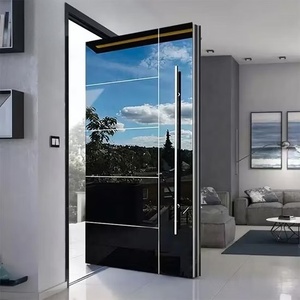
Frameless glass entry doors represent the pinnacle of modern architectural minimalism. By eliminating opaque peripheral framing, these systems maximize daylight penetration, provide uninterrupted line-of-sight visual continuity, and establish an immediate luxury positioning for high-end residential villas, commercial headquarters, luxury retail flagships, and hospitality projects. However, removing structural metal frames shifts the entire structural load-bearing and environmental sealing burden onto the glass pane itself and its precision-engineered mounting hardware.
When sourcing frameless glass entry doors from China, B2B buyers—including facade engineers, procurement managers, real estate developers, and general contractors—must evaluate manufacturers based on rigorous material testing, precision glass tempering capabilities, hardware load capacities, and regional building code compliance (such as North American NFRC/ASTM, Australian AS2047/AS1288, and European CE/EN standards).
2. Material Science & Structural Engineering Fundamentals
The structural design of frameless glass entry doors requires careful calculation of wind load resistance, deflection criteria ($L/175$ or $L/240$), impact safety, and thermal stress. The selection of glass substrate and interlayer chemistry is paramount to preventing structural failure and ensuring long-term operational safety.
2.1 Glass Processing: Monolithic Tempered vs. SGP Laminated Glass
To achieve frameless structural rigidity, Chinese tier-1 factories utilize fully toughened (tempered) glass processed in horizontal force-convection tempering furnaces. Tempered glass possesses surface compression exceeding $90 \text{ MPa}$ ($13,000 \text{ psi}$), making it 4 to 5 times stronger than standard annealed glass.
For high-traffic public entrances, hurricane-prone regions (e.g., Florida HVHZ zones), or oversized pivot doors exceeding 3.0 meters in height, SGP (SentryGlas® Ionoplast) interlayers are highly recommended over standard PVB (Polyvinyl Butyral). The SGP interlayer is 100 times stiffer and 5 times tear-resistant compared to PVB. In the rare event of glass fracture, an SGP laminated glass door panel retains its structural upright posture under load, whereas PVB laminates slump and collapse.
2.2 Ultra-Clear Low-Iron Glass & Heat Soak Testing (HST)
Standard clear float glass contains minor iron oxide impurities, imparting a noticeable green tint along the exposed polished edges of a frameless door. Premium Chinese suppliers utilize Low-Iron (Solar White/Optiwhite) Glass with iron content below 0.015%, delivering crystal-clear edge aesthetics and superior light transmittance ($\ge 91\%$).
Furthermore, to eliminate the risk of spontaneous glass breakage caused by microscopic Nickel Sulfide ($\text{NiS}$) inclusions in toughened glass, export-grade orders undergo mandatory Heat Soak Testing (HST) in accordance with EN 14179-1 standards. During HST, glass panels are subjected to a controlled thermal cycle of $290^\circ\text{C} \pm 10^\circ\text{C}$ for two hours, intentionally inducing fracture in any inclusion-contaminated panels inside the factory chamber before export crating.
| Specification Parameter | 12mm Monolithic Tempered | 15mm Ultra-Clear Tempered | 17.52mm SGP Laminated (8+1.52SGP+8) | 21.52mm SGP Laminated (10+1.52SGP+10) |
|---|---|---|---|---|
| Structural Application | Standard Interior / Low Wind Exterior | Commercial Entry (up to 2.8m) | High-Traffic / Hurricane Exterior | Oversized Architectural Pivot (up to 4.0m) |
| Bending Strength (EN 12150) | $\ge 120 \text{ N/mm}^2$ | $\ge 120 \text{ N/mm}^2$ | $\ge 160 \text{ N/mm}^2$ (Combined) | $\ge 180 \text{ N/mm}^2$ (Combined) |
| Impact Resistance Class | Class 1(C)1 (EN 12600) | Class 1(C)1 (EN 12600) | ASTM E1996 Large Missile Level D | ASTM E1996 Large Missile Level E |
| Post-Breakage Rigidity | Collapses into small blunt dice | Collapses into small blunt dice | Remains rigid upright panel | Superior structural self-standing stability |
| Weight per Sq. Meter | $30.0 \text{ kg/m}^2$ | $37.5 \text{ kg/m}^2$ | $42.0 \text{ kg/m}^2$ | $52.0 \text{ kg/m}^2$ |
3. Precision Hardware & Motion Control Systems
A frameless glass entry door is only as reliable as its hardware components. Because glass cannot be drilled or modified post-tempering, hardware cutout geometry (patch fittings, lock cutouts, pivot notches) must be executed with millimeter precision using CNC waterjet and automatic glass machining centers.
3.1 Heavy-Duty Hydraulic Floor Springs & Patch Fittings
Frameless swing doors rely on bottom hydraulic floor springs or concealed hydraulic patch fittings to control closing force, hold-open positions ($90^\circ$ or $105^\circ$), and backcheck damping. Top-tier Chinese manufacturers integrate German-engineered or premium domestic hydraulic cylinders tested to 500,000 operational cycles (EN 1154 compliance).
- Stainless Steel Grade: Hardware housing and visible patch covers must utilize forged AISI 316 or 304 stainless steel with surface finishes in Brushed Satin, Polished Mirror, Matte Black, or Physical Vapor Deposition (PVD) Titanium Gold.
- Load Capacity Rating: Heavy-duty floor springs support door leaf weights up to $300 \text{ kg}$ and leaf widths up to $1,500 \text{ mm}$.
- Zero-Sag Pivot Adjustability: Multi-directional alignment screws embedded within the bottom patch allow $\pm 5\text{mm}$ lateral and longitudinal micro-adjustments on-site to ensure perfectly uniform $3\text{mm}$ perimeter glass gaps.
3.2 Weather Sealing & Acoustic Mitigation Engineering
The primary historical criticism of frameless glass doors has been perimeter air infiltration and acoustic leakage. Modern Chinese manufacturing overcomes this through specialized architectural sealing components:
Polycarbonate Fin Seals
UV-stabilized clear PVC/polycarbonate dynamic fin gaskets snap onto $12\text{mm}-19\text{mm}$ glass edges, creating dual-line contact seals that block wind-driven rain while maintaining visual transparency.
Magnetic Interlocking Strips
For double-door active/passive leaf pairs, rare-earth magnetic polycarbonate profile strips draw door edges tightly together upon closure, significantly enhancing acoustic STC ratings.
Concealed Drop-Down Seals
Automated hydraulic drop-down sweep seals built into bottom stainless rail patches automatically lower a neoprene gasket against the finished floor threshold when the door closes.
4. Future Procurement & Industry Development Trends (2025–2030)
The global market for architectural entry doors is shifting rapidly toward intelligent functional integration, sustainability, and ultra-large dimensions. Importers and developers sourcing from China should align their procurement strategies with the following technology trends:
4.1 Integration of Smart Electrochromic (PDLC) Switchable Glass
Privacy-on-demand technology is transitioning from interior partition walls to main entryways. By laminating a Polymer Dispersed Liquid Crystal (PDLC) film between two layers of glass, the frameless entry door transforms from 85% transparent to opaque frosted white within 100 milliseconds upon electrical excitation ($48\text{V} \text{ AC}$). Leading Chinese factories now offer pre-wired pivot patch hardware with concealed slip-ring electric power transfer hinges, eliminating visible wires.
4.2 Thermal Break Frameless Hybrid Pivot Systems
To meet stringent energy codes (such as IECC in the US or Part L in the UK), manufacturers in Foshan have developed double-glazed and triple-glazed vacuum insulated frameless hybrid doors. By concealing ultra-narrow thermal-break aluminum perimeter channels ($< 15\text{mm}$ visible width) with black ceramic frit printed glass borders, the assembly delivers the visual illusion of a pure frameless door while achieving U-values as low as $1.1 \text{ W/m}^2\text{K}$ ($0.19 \text{ BTU/h}\cdot\text{ft}^2\cdot^\circ\text{F}$).
4.3 Biometric & Smart Access Control Hardware Integration
Traditional mechanical locks are rapidly being replaced by patch-integrated smart hardware featuring 3D facial recognition, capacitive fingerprint scanners, magnetic locks ($600 \text{ kg}$ holding force), and encrypted Bluetooth/Wi-Fi modules seamlessly mounted inside slim bottom/top stainless steel rails.
5. Why Source Frameless Glass Doors from China (DERKA Enterprise Advantage)
China's architectural glass and window industry leads global output, with the Foshan manufacturing hub serving as the epicenter for architectural metalwork and tempered glass processing. Operating within this advanced ecosystem, Foshan Derka Architectural Doors & Windows Co., Ltd. provides global buyers with unmatched manufacturing capacity, rigorous compliance verification, and factory-direct pricing.
115,000 m² Automated Manufacturing Base
Equipped with 9 specialized production lines running 16 hours daily, backed by over 700 skilled technicians and design engineers. Massive scale guarantees stable lead times and volume throughput for commercial developments.
44-Point Mandatory QC Protocol
Every frameless glass order undergoes 44 documented inspection checkpoints—from raw glass flatness and roller wave distortion checks to CNC notch tolerances, anodizing thickness, hydraulic pressure testing, and pre-shipment trial assembly.
Global Standard Certifications
Fully certified under ISO 9001 quality management systems. Product lines carry full test documentation for CE marking (Europe), AS2047 & AS1288 (Australia), and NFRC / CSA (North America), simplifying site sign-offs and customs clearance.
Export-Grade A-Frame Crating
Heavy structural glass units are wrapped in corner-protecting film, separated by cork pads, and sealed inside fumigated solid plywood A-frame crates labeled by opening schedule, preventing transit breakage across long sea freight routes.
6. B2B Procurement Step-by-Step Workflow & Quality Verification Checklist
To mitigate sourcing risks when ordering architectural glass doors directly from Chinese factories, professional buyers should execute the following 5-stage procurement protocol:
- Stage 1: Architectural Drawing Review & Wind Load Calculation
Submit door opening schedules, floor elevation plans, and local design wind pressures ($\text{kPa}$). Factory facade engineers return CAD/BIM shop drawings detailing glass thickness, hardware cutout dimensions, and structural calculations. - Stage 2: Sample & Hardware Finish Sign-off
Verify PVD hardware coating samples, glass clarity (low-iron verification), and seal gasket cross-sections via express courier before mass production authorization. - Stage 3: Factory Acceptance Testing (FAT) & Live Inspection
During assembly, review glass stress-polariscope reports (verifying uniform temper), edge grinding quality, and dimensional tolerance ($\pm 1\text{mm}$). Buyers can utilize third-party inspectors (SGS/TÜV) or request live video audit feeds. - Stage 4: Trial Mock-up Assembly
The factory sets up a 1:1 structural mounting frame to test floor spring alignment, latch engagement, closing speed damping, and drop-down seal deployment. - Stage 5: Container Loading & Logistics Tracking
Crates are loaded using overhead gantry cranes, braced with steel strapping, and moisture-sealed with industrial desiccant bags inside dry shipping containers.
7. Frequently Asked Questions (FAQ) for B2B Importers & Architects
What is the maximum safe height and width for a frameless glass entry door?
For standard single-action or double-action swing doors using 12mm or 15mm toughened monolithic glass, maximum recommended dimensions are typically $1,200\text{mm}$ in width by $3,000\text{mm}$ in height. However, utilizing 17.52mm or 21.52mm SGP laminated structural glass with heavy-duty hydraulic floor pivots enables custom architectural pivot entry doors to reach dimensions up to $2,000\text{mm}$ wide by $4,000\text{mm}$ high, provided structural floor anchor depth is adequate.
How do frameless glass entry doors perform under severe wind load and weather conditions?
Monolithic frameless glass doors are primarily designed for interior vestibules, covered entrances, or mid-climate exterior facades. For exterior openings exposed to high wind pressures ($> 1.5\text{ kPa}$) or hurricane zones, we recommend laminated SGP glass engineered with structural perimeter interlocking aluminum channels and continuous EPDM seal strips. This hybrid setup retains frameless aesthetics while passing air, water, and structural wind load requirements under standards such as ASTM E330 and AS2047.
Why is Low-Iron (Ultra-Clear) glass strongly specified for frameless door edges?
Standard float glass contains higher levels of iron oxide, which produces a prominent dark green tint along polished glass edges. In frameless doors where the vertical and top glass edges remain exposed, Low-Iron glass eliminates this green cast, delivering crystal-clear optical transparency and clean, modern edge aesthetics that match high-end interior finishes.
What surface finishes are available for stainless steel patch fittings and locks?
Standard finishes include Satin Brushed (SSS) and Mirror Polished (PSS) grade 304 or 316 stainless steel. For modern luxury aesthetics, hardware undergoes Physical Vapor Deposition (PVD) coating, offering Matte Black, PVD Titanium Gold, Rose Gold, Antique Bronze, and Satin Gunmetal finishes. PVD coatings provide superior scratch resistance and salt-spray corrosion protection ($> 480 \text{ hours}$ NSS test compliance).
How are quality control and dimensional tolerances managed before shipping?
Each glass panel is cut, ground, and drilled on CNC automated machinery to maintain tolerances within $\pm 0.5\text{mm}$. After tempering and optional Heat Soak Testing (HST), hardware patch fittings are pre-installed in the factory to verify hole alignment, hinge clearance, and latch mechanism function. Inspection reports accompanied by high-resolution video and photo documentation are shared prior to crating.
What is the typical manufacturing lead time for custom export orders?
Standard manufacturing lead time for custom engineered frameless glass door packages is 20 to 25 calendar days following shop drawing approval and deposit receipt. For complex projects requiring specialized SGP laminating, ceramic frit border printing, or PVD custom hardware finishes, production lead time is typically 28 to 35 days.
Ready to Engineer Your Project's Frameless Glass Entry System?
Contact DERKA's architectural engineering team today for shop drawing assistance, wind load calculations, factory-direct wholesale pricing, and sample packages.